Published 1 month ago by Saurabh Kathuria
During a recent discussion with one of our clients, an interesting question came up:
"What instructional design principles and frameworks will you use to develop this learning program?"
It's a question that every Instructional Designer faces every project because each project involves different learners, different learning objectives, and different desired outcomes. With so many established theories, models, and frameworks available, selecting the right approach has always been both a challenge and a responsibility.
At Infonative Solutions, we have consistently developed learning and training solutions using proven instructional design principles grounded in decades of research into how people learn.
The Foundations of Learning
Modern instructional design has its roots in three foundational learning theories:
- Behaviorism focuses on shaping observable behavior through reinforcement, feedback, rewards, and consequences.
- Cognitivism examines how the human mind processes, stores, and retrieves information.
- Constructivism emphasizes that learners actively build knowledge through experience, reflection, and social interaction.
These foundational theories have inspired generations of researchers and practitioners, resulting in numerous instructional models that continue to influence learning design today.
The Thinkers Who Shaped Instructional Design
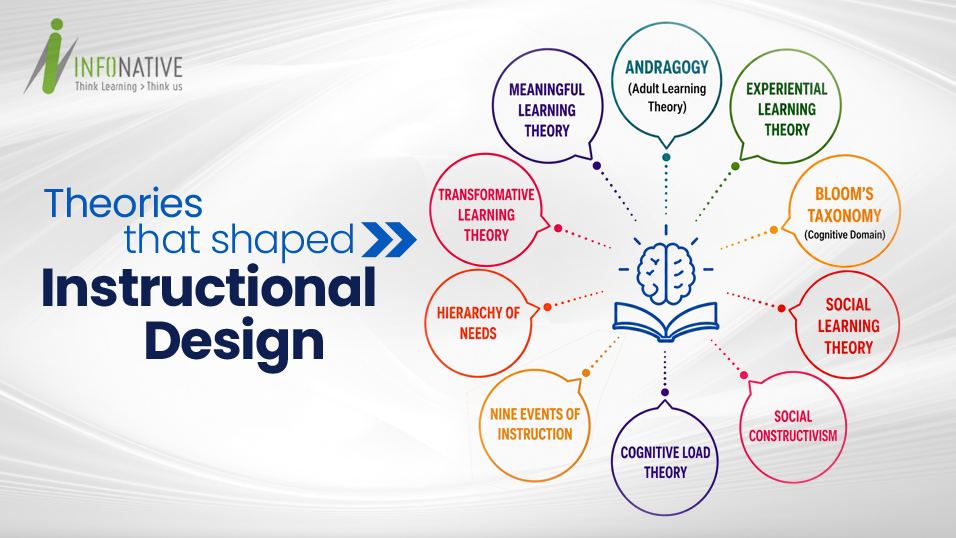
Every Instructional Designer, consciously or unconsciously, draws from the work of these or other pioneers:
- John Dewey – Experiential Learning and Project-Based Learning
- Jean Piaget – Constructivism and Cognitive Development
- Jerome Bruner – Discovery Learning
- Erik Erikson – Psychosocial Development
- Malcolm Knowles – Andragogy and Adult Learning
- Jack Mezirow – Transformative Learning
- David Kolb – Experiential Learning Cycle
- Reg Revans – Action Learning
- Donald Kirkpatrick – Learning Evaluation Model
- Albert Bandura – Social Learning Theory
- Benjamin Bloom – Bloom's Taxonomy
- David Krathwohl – Revised Bloom's Taxonomy
- M. David Merrill – First Principles of Instruction
- Robert Gagné – Nine Events of Instruction
- Lev Vygotsky – Social Constructivism
- David Ausubel – Meaningful Learning Theory
- Howard Gardner – Multiple Intelligences
- Daniel Goleman – Emotional Intelligence
- Edward Thorndike – Laws of Learning
- B. F. Skinner – Behaviorism
- Abraham Maslow – Hierarchy of Needs
- Dugan Laird – Sensory Theory and Training & Development
These theories have shaped instructional design for decades and continue to influence how effective learning experiences are created.
But What About AI?
Today, Artificial Intelligence is transforming almost every profession, and Learning & Development is no exception.
AI can generate content within seconds. It can create quizzes, learning objectives, scenarios, videos, assessments, and even complete eLearning modules. This naturally raises an important question:
Do instructional design theories still matter when AI can generate learning content?
My answer is a clear yes.
AI Can Create Content. It Cannot Replace Human Learning Science.
Technology evolves rapidly, but the way the human brain learns has not fundamentally changed.
People still:
- Process information through attention and memory.
- Learn through practice and experience.
- Build understanding based on prior knowledge.
- Require motivation and relevance.
- Change behavior through reinforcement, reflection, and application.
These are principles of human psychology—not technology.
AI can accelerate content creation, but it does not change how humans absorb knowledge, retain information, develop skills, or modify behavior.
The Role of the Instructional Designer Is Becoming More Important
Ironically, AI may increase the importance of skilled Instructional Designers rather than diminish it.
Instead of spending most of their time creating content, Instructional Designers will increasingly focus on:
- Identifying learning gaps.
- Understanding learner personas.
- Selecting the most appropriate learning strategies.
- Structuring learning journeys.
- Deciding what learners should know versus what they can discover.
- Choose the right blend of learning formats.
- Measuring learning effectiveness and business impact.
AI can assist with execution, but strategy still requires human expertise.
Will Instructional Design Principles Change?
Certainly.
Some instructional methods will evolve as AI-powered learning becomes more personalized, conversational, and adaptive. New frameworks will emerge to address AI tutors, intelligent coaching, immersive simulations, and data-driven personalization.
However, these innovations will build upon—not replace—the fundamentals of human learning.
The principles developed by Dewey, Piaget, Bruner, Gagné, Bloom, Knowles, Bandura, Kolb, Merrill, and many others remain highly relevant because they are based on how humans think, learn, and behave.
The way ahead...
Artificial Intelligence is transforming how we create learning, but it is not changing how humans learn.
The future of instructional design will belong to professionals who combine the efficiency of AI with a deep understanding of learning science.
Technology may become smarter, but effective learning will always begin with understanding the learner.
The principles may evolve. The tools will certainly change
But the science of learning remains as relevant today as it has ever been.