Published 2 months ago by Arman Singh
A few months ago, a manufacturing company rolled out access to several AI tools for its employees. The leadership team expected productivity gains almost immediately.
Three months later, the results were mixed.
A small group of employees had become power users. They were using AI to create reports, analyze data, write emails, and automate routine tasks. However, most employees were still experimenting randomly or avoiding the tools altogether.
The problem wasn't technology.
The problem was learning.
This story is becoming increasingly common across industries. Organizations are investing in AI, but many employees are still unsure about where to begin, what to learn, and how to use AI effectively in their daily work.
According to the World Economic Forum's Future of Jobs Report 2025, AI and Big Data are expected to be the fastest-growing skill areas over the next five years, making workforce upskilling a top priority for employers.
Information Is Everywhere. Capability Is Not.
Today, employees can access thousands of AI resources online:
● YouTube tutorials
● Online courses
● Blogs and newsletters
● Webinars and podcasts
● AI communities and forums
The challenge is not finding information.
The challenge is making sense of it.
Employees often ask:
● Which AI tools are relevant to my role?
● What should I learn first?
● Which resources are credible?
● How do I apply AI to my actual work?
Without guidance, many people spend hours exploring tools without developing practical skills that create business value.
Why Structured Learning Matters
Think about learning to drive.
Giving someone access to a car doesn't automatically make them a good driver. They need training, practice, feedback, and real-world experience.
AI learning works in much the same way.
Research on AI adoption in the workplace has shown that employees gain the most value when AI is integrated into their workflows and supported through learning and practice. In one large-scale study, access to AI assistance improved worker productivity by approximately 15%, particularly among less experienced employees.
Organizations that simply provide AI tools may see isolated success stories. Organizations that build learning ecosystems are more likely to create widespread capability.
What an AI Learning Ecosystem Looks Like
A structured AI learning ecosystem goes beyond training courses.
It helps employees:
● Understand AI fundamentals
● Learn role-specific applications
● Practice using AI safely
● Experiment with real business scenarios
● Share best practices
● Validate skills through assessments and projects
This approach transforms AI from an interesting technology into a practical business capability.
Many industry experts now argue that AI readiness is fundamentally a learning and capability challenge rather than a technology challenge.
Building AI Capability Across the Organization
At Infonative, we help organizations create AI learning ecosystems that support employees at every stage of their AI journey.
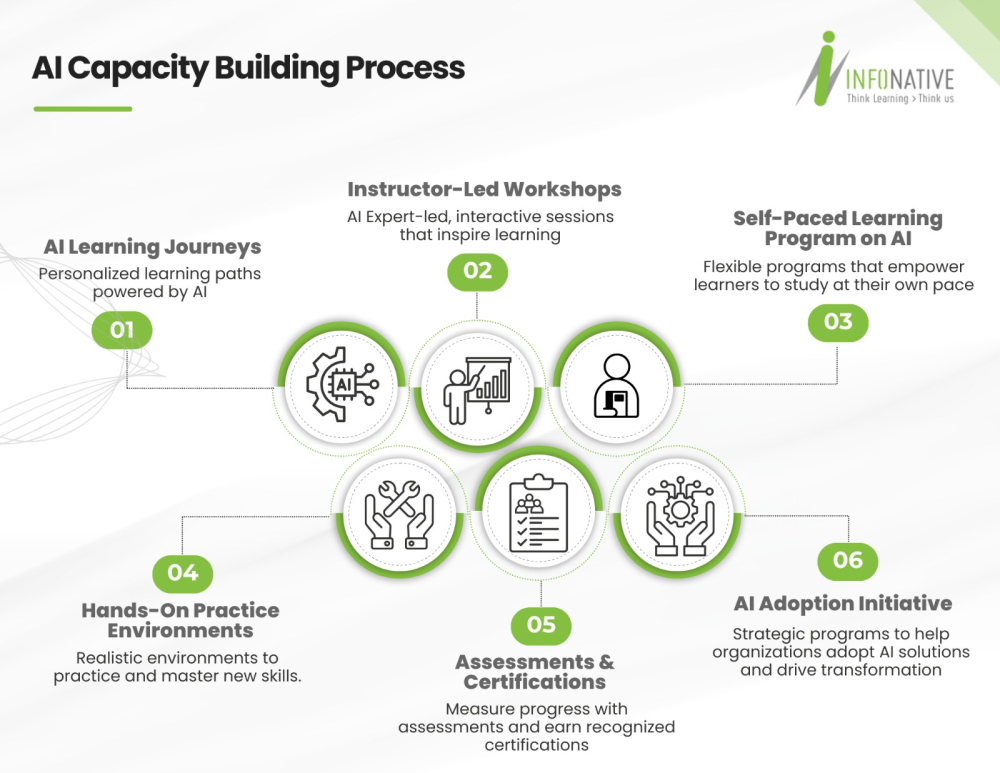
Our team works with organizations to design:
● AI learning journeys
● Instructor-led workshops
● Self-paced learning programs
● Hands-on practice environments
● Assessments and certifications
● AI adoption initiatives
● Role-based learning pathways
We also provide access to trainers and practitioners with expertise across a wide range of AI domains, including:
1. Generative AI
Practical applications for content creation, research, productivity, customer support, and business automation.
2. AI and Machine Learning (AI/ML)
Core concepts, models, implementation approaches, and business use cases.
3. RAG and Agentic RAG
Building AI systems that combine reasoning capabilities with enterprise knowledge.
4. AI Coding and Development Tools
Training on emerging platforms such as Claude Code, Codex, Kiro, GitHub Copilot, Cloud Code, and other AI-assisted development tools.
5. AI-Enabled Development Workflows
Using AI across coding, testing, debugging, documentation, and deployment activities.
6. Data Engineering and Cloud Architecture for AI
Preparing data and infrastructure for scalable enterprise AI initiatives.
7. Future of AI and Emerging Technologies
Helping teams stay current with rapidly evolving tools, frameworks, and industry trends.
Turning AI Knowledge Into Business Results
The organizations that succeed with AI will not necessarily be those that buy the most tools.
They will be the organizations that help their people learn fastest.
A recent PwC AI Jobs Barometer found that organizations increasingly view AI as a way to enhance workforce productivity and value rather than simply replace jobs.
The opportunity is clear: move beyond AI awareness and build real AI capability.
With the right learning ecosystem, employees can confidently apply AI in their daily work, improve productivity, accelerate innovation, and create measurable business impact.