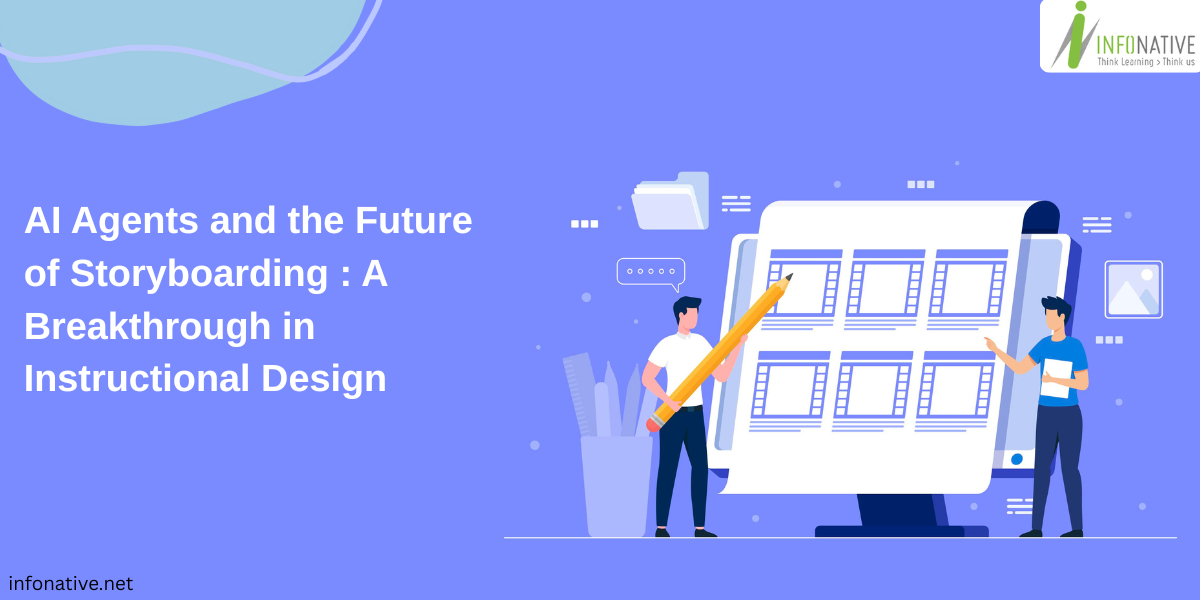


The world of instructional design is undergoing one of its most significant transformations to date. As organisations demand faster development cycles, more personalised learning experiences, and greater efficiency, AI agents have emerged as a breakthrough technology—especially in the field of storyboarding. Traditionally, creating instructional storyboards has required extensive time, manual effort, and cross-functional collaboration. Today, AI agents are redefining this process, offering unparalleled automation, accuracy, and creative support.
This article explores how AI agents are shaping the future of storyboarding and why they represent a major leap forward for instructional designers, training teams, and eLearning organisations.
The Traditional Challenge of Storyboarding
Storyboarding has always been the backbone of eLearning development. It outlines the narrative, screens, interactions, visuals, and learning flow before course creation begins. However, traditional storyboard creation often involves several challenges:
• Time-intensive drafting and revisions
• Misalignment between designers, SMEs, and developers
• Inconsistencies in tone, content depth, or instructional flow
• Limited ability to rapidly personalise storyboards for diverse learners
• Repetitive manual formatting and structuring
As training needs accelerate, the pressure on instructional designers to deliver high-quality content faster has intensified. This is where AI agents come in—offering unprecedented support throughout the storyboard lifecycle.
How AI Agents Are Revolutionising Storyboarding
AI agents are more than standard automation tools—they are intelligent assistants capable of interpreting requirements, generating draft content, streamlining collaboration, and accelerating production. Their role in modern instructional design is quickly becoming indispensable.
1. Automating Initial Storyboard Drafts
With only a learning brief or SME notes, AI agents can produce:
• Detailed chapter and module breakdowns
• Content sequences aligned to learning objectives
• Screen-by-screen instructions
• Suggested visuals, interactions, and assessments
This automation helps designers begin with a strong foundation rather than a blank page, reducing hours of manual work.
2. Enhancing Instructional Accuracy and Consistency
AI agents can apply instructional design principles such as:
• Bloom’s taxonomy
• Gagné’s Nine Events
• Adult learning theory
• Scenario-based learning techniques
By ensuring consistent application of methodology across storyboards, AI reduces human error and keeps content pedagogically sound.
3. Visual and Multimedia Recommendations
Modern AI agents can recommend or even generate:
• Visual concepts
• Iconography and layout suggestions
• Narration scripts
• Interactive storyboard components
• Microlearning snippets and scenario flows
This enriches the storyboard with multimedia thinking early in the design phase.
4. Real-Time Collaboration and Rapid Revisions
AI agents can process SME feedback instantly and update storyboards in seconds. This eliminates lengthy feedback cycles and minimises communication gaps. Designers can also maintain multiple versions effortlessly using AI-assisted version control.
5. Personalisation at Scale
One of the most powerful capabilities of AI agents is hyper-personalisation. They can generate variations of the same storyboard for different:
• Skill levels
• Job roles
• Industries
• Languages
• Compliance requirements
This level of customisation was previously impossible at scale without massive resources.
Why AI-Driven Storyboarding Is a Breakthrough for Instructional Design
AI agents are not replacing instructional designers—they are empowering them. Here’s how:
1. Increased Productivity
AI reduces hours spent on manual storyboarding tasks, allowing designers to focus on creative storytelling, engagement strategies, and learner experience.
2. Higher Quality Outcomes
With AI ensuring consistency, structure, and adherence to learning science, the final instructional product becomes more effective and polished.
3. Faster Turnaround Times
Organisations can now deploy training faster, supporting agile development cycles and just-in-time learning needs.
4. Better Use of Human Expertise
Designers spend more time refining ideas and collaborating strategically rather than on repetitive formatting or content drafting.
5. Scalability
Whether producing one course or an entire curriculum, AI-assisted storyboarding scales effortlessly across multiple projects.
Applications Across Training and eLearning Industries
AI-driven storyboarding is now being adopted across diverse sectors, including:
• Corporate training – onboarding, compliance, leadership programmes
• Education – digital lessons, adaptive learning modules
• Healthcare – clinical simulations and SOP-based training
• Finance – high-accuracy process and regulation-based content
• Technology – product training, software tutorials, simulations
Any industry that relies on structured learning can benefit from AI-powered storyboard transformation.
The Future: Intelligent and Autonomous Storyboarding
Looking ahead, AI agents will play an even more advanced role in instructional design. Future capabilities may include:
• Fully autonomous storyboarding systems
• Auto-generated prototypes in Storyline, Captivate, or Rise
• AI agents collaborating with each other to complete sub-tasks
• Voice-controlled storyboard design
• Real-time analytics to improve storyboard flow based on learner data
The evolution is set to redefine how eLearning is designed, developed, and delivered.
Conclusion
AI agents represent a major breakthrough in the future of storyboarding and instructional design. By automating content creation, enhancing accuracy, supporting personalisation, and accelerating revisions, they are transforming how digital learning is conceptualised and executed.
As organisations continue to adopt AI-powered solutions, instructional designers who embrace this shift will gain a competitive edge—producing high-quality eLearning experiences faster, smarter, and with greater impact.