Published 7 October 2026
The dust around AI has settled, and the world is starting to realize that AI is also a tool for creating a Human Edge.
During a discussion with the Head of Business Development of a manufacturing company about how AI is affecting businesses, one analogy that came up was sports equipment. Anyone can easily buy the same equipment used by the best player in the world. But does having the best equipment make someone a champion? The obvious answer is that it does not.
Today, AI is easily accessible and cost effective too. Everyone can access one AI tool or another. But does that automatically give them an edge?
During the discussion, it became clear that any tool, even the best AI, can only support the effort to success. One need to have sharper skills to become a champion.
This is exactly what is happening in the eLearning world, also.
Creating Content Is Easy. Ensuring Learning Is Not.
It is easy to write text, create an image, or develop a video using AI. But does easily created content really engage learners? More importantly, does it help them apply what they have learned at work?
Imagine a company using AI to create a 30-minute course on customer service. The course may have attractive visuals, realistic conversations, and a professionally produced voiceover. But if employees still struggle to handle an angry customer, has the course achieved its purpose?
The problem may not be the quality of the content. It may be the absence of meaningful practice, relevant scenarios, and feedback that helps employees improve.
AI can help create the content. Instructional design ensures that the content serves a learning objective.
Too Much Information Can Become Learning Waste
Information is everywhere and easily accessible. That is precisely the problem. There is so much to read, explore, and understand that finding the time to learn what truly matters has become a challenge. Too much information can be one of the biggest wasters for learners.
When there is too much content, the real art lies in eliminating waste from eLearning and keeping only what is necessary. When there are too many distractions, focus becomes the key to success.
Consider a manufacturing company introducing a new safety procedure. An AI tool can quickly generate a lengthy course covering every related safety concept. But does every employee need to learn all of it?
An operator may need to identify a specific hazard, follow a shutdown procedure, and know when to escalate an issue. A concise, scenario-based learning experience focused on these critical actions may be more useful than a lengthy course filled with information the operator does not need.
The objective is not to teach everything. It is to teach what matters.
The New Role of Instructional Designers: Eliminate Learning Waste
AI is producing more content and making it easier to find answers to almost any question. This is where instructional designers and well-designed custom eLearning solutions become extremely important: they cut through the clutter and retain only what learners need to know, understand, and apply.
The new role of instructional designers is not simply to create learning content faster. It is to eliminate waste from eLearning.
This includes unnecessary information, repetitive explanations, confusing navigation, irrelevant interactions, and assessments that test memory without measuring the ability to apply knowledge.
For example,
Imagine a sales team launching a new product. AI can create product descriptions, presentations, and quizzes in minutes. However, successful selling requires more than product knowledge. Instructional Designers, working closely with Subject Matter Experts (SMEs), provide real-world context through industry or company-specific case studies, practical scenarios, and experience-based insights. This enables sales representatives to clearly communicate the product’s value, address customer objections with confidence, and effectively differentiate it from competing solutions.
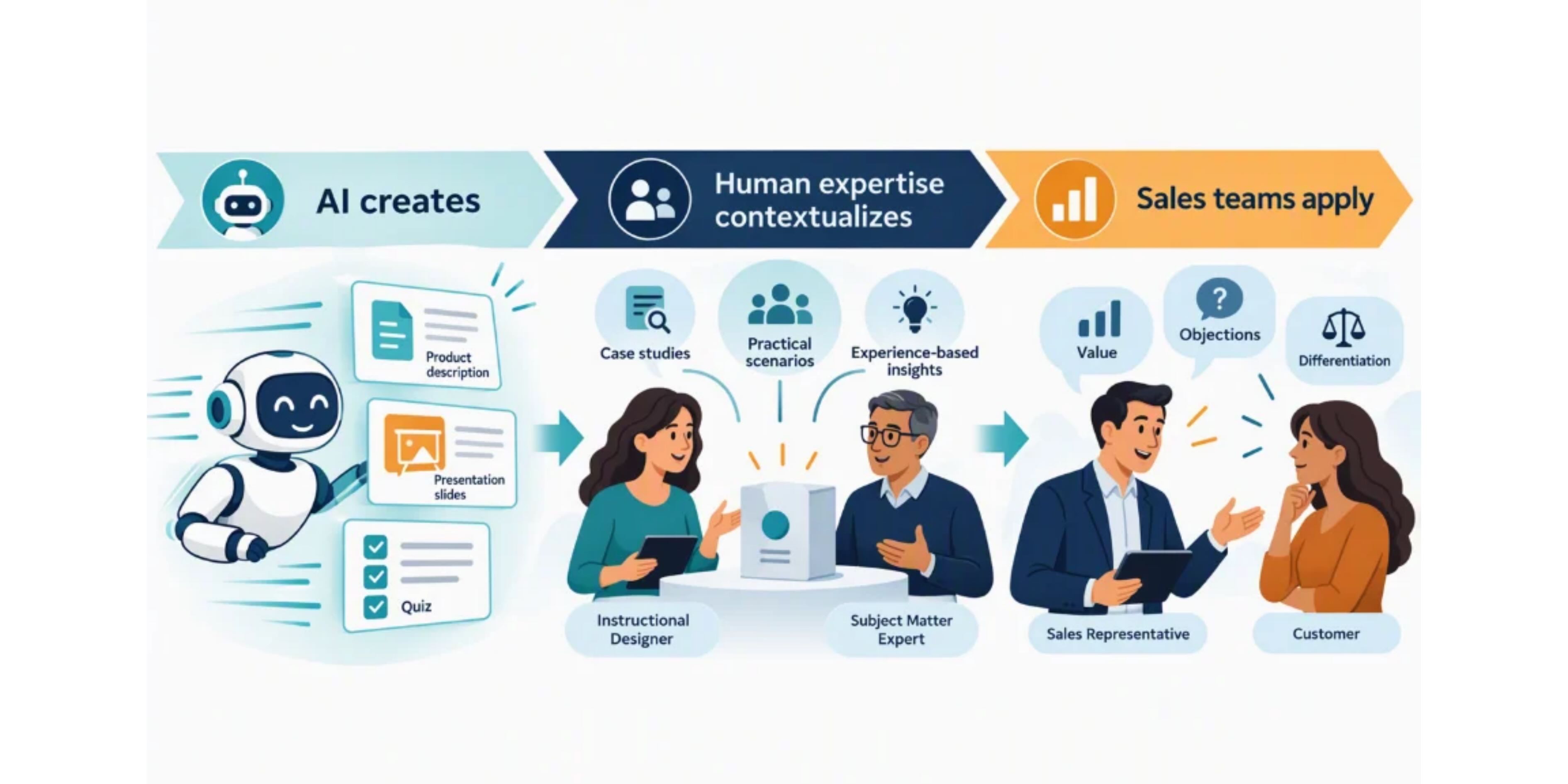
An instructional designer can turn that information into realistic buyer conversations, decision-making exercises, and targeted feedback. The result is not merely a course about the product. It is a learning experience designed to prepare employees for actual sales conversations.
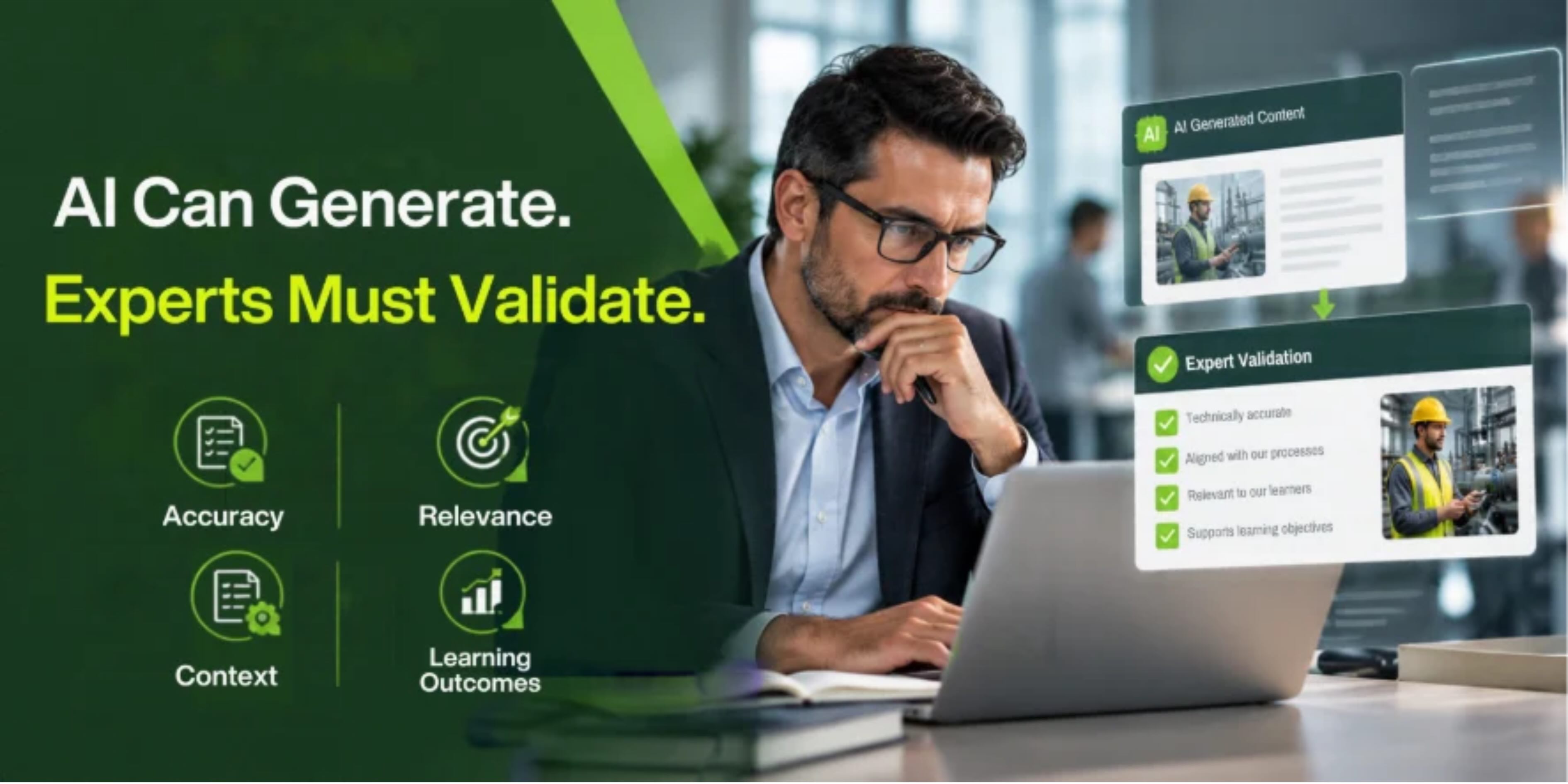
Human expertise is also essential for reviewing AI-generated content. Warning by AI itself - AI can make errors! AI can produce wrong information, miss relevant context, or give examples that do not reflect an organization's processes.
Subject matter experts and instructional designers must validate the content, ensure its relevance, and make sure it supports the intended learning outcomes.
Custom eLearning: From Content to Competitive Advantage
In an L&D world focused on speed to created eLearning, custom eLearning is becoming a strategic advantage. It may not be necessary for every learning objective, but when organizations face specific business challenges, it is a powerful tool to build a Human Edge.
Off-the-shelf courses can be effective for common topics such as general communication skills or basic cybersecurity awareness. However, when learning must address a company's unique processes, products, customer interactions, safety requirements, or business challenges, a more customized approach is mandatory.
For example, two banks may both need customer service training. Yet their products, compliance requirements, customer profiles, systems, and service standards will differ significantly. A generic course can explain customer service principles, but a custom eLearning solution can prepare employees for the specific conversations and decisions they face in their own workplace.

The difference lies in relevance, practice, and application.
Creating the Human Edge at Infonative Solutions
At Infonative Solutions, we believe that effective custom eLearning development is not about producing more content. It is about solving specific knowledge, skill, or behavioral challenges.
We combine human expertise, instructional design, creativity, and technology to create learning experiences that focus on what matters most. AI can accelerate content creation, but the real value comes from knowing what to include, what to remove, and how to help learners apply what they learn.
Our custom eLearning solutions help organizations focus their learning investments on critical capabilities, enabling employees to perform better and build a lasting Human Edge.
Because in the age of AI, the advantage will not belong to those who create the most content. It will belong to those who create the most meaningful learning.