Published 3 months ago by Arman Singh
Every day, millions of products move through warehouses globally, yet many shipments are delayed, mislabeled, misplaced, or delivered incorrectly - resulting in billions of annual losses for businesses. [Refer - Ecommerce Return Statistics 2026]
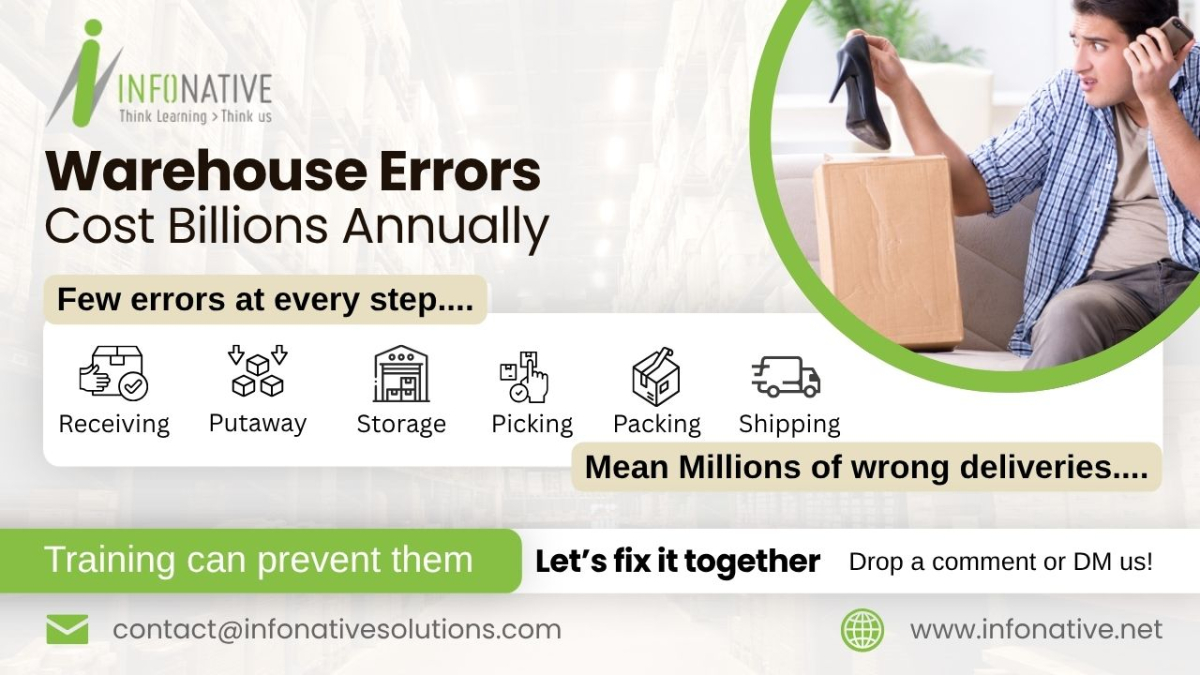
The real question is: why does this continue despite advanced systems and technologies?
Let's explore.
The 6 Core Stages of Warehouse Operations
Every warehouse operates through six critical stages:
- Receiving
- Putaway
- Storage
- Picking
- Packing
- Shipping

A failure at any one stage creates a ripple effect across operations. Incorrect putaway can lead to misplaced inventory, picking errors can result in wrong shipments, and poor packaging or labeling can impact customer experience and brand reputation.
Common Warehouse Challenges
Some of the most frequent operational issues include:
- Incorrect bin allocation
- Misplaced inventory
- Picking and quantity errors
- Packaging and labeling mistakes
- Poor adherence to SOPs
Studies suggest that a major percentage of warehouse errors are linked to insufficient training and lack of process understanding.
[Refer - Warehouse Safety Culture and Safety Training]
Technology Alone Is Not Enough
Many organizations blame systems or processes, but the real issue is often undertrained teams.
Even the best warehouse management systems fail when employees:
- Lack operational clarity
- Do not understand workflows
- Are unfamiliar with SOPs
- Are not trained for accuracy and exception handling
This is why workforce capability development is becoming critical across manufacturing, FMCG, telecom, logistics, oil & gas, and related industries.
The Role of eLearning Solutions for Manufacturing Industry
Organizations can adopt eLearning solutions for manufacturing industry and warehouse operations to improve workforce efficiency and reduce operational errors.
Digital learning helps organizations:
- Standardize operational knowledge
- Improve compliance
- Reduce human errors
- Accelerate onboarding
- Improve productivity and shipping accuracy
Learning delivered through videos, simulations, microlearning, SOP-based modules, and interactive content creates measurable operational improvements.
How Infonative Solutions Helps
Infonative Solutions works with organizations across manufacturing and operational industries to improve workforce capability through targeted learning interventions.
Our solutions help organizations:
- Improve warehouse process awareness
- Reduce operational errors
- Strengthen SOP adherence
- Improve productivity
- Support behavioral and operational transformation
We combine industry expertise, learning design, AI-enabled learning solutions, interactive content, and analytics-driven approaches to create scalable workforce transformation programs.
What Next
Warehouse inefficiencies are often learning and capability gaps hidden within operations.
Organizations that invest in workforce learning and operational capability development achieve:
- Better accuracy
- Lower operational costs
- Improved customer experience
- Stronger business performance
The future of warehouse excellence will be driven not just by automation, but by skilled and well-trained teams.
This blog is based on a warehouse management program that we developed for one of the leading global MNCs in the retail sector. Contact us to view a sample, discuss the program, and explore how Infonative Solutions can help your organization improve warehouse efficiency and workforce performance.